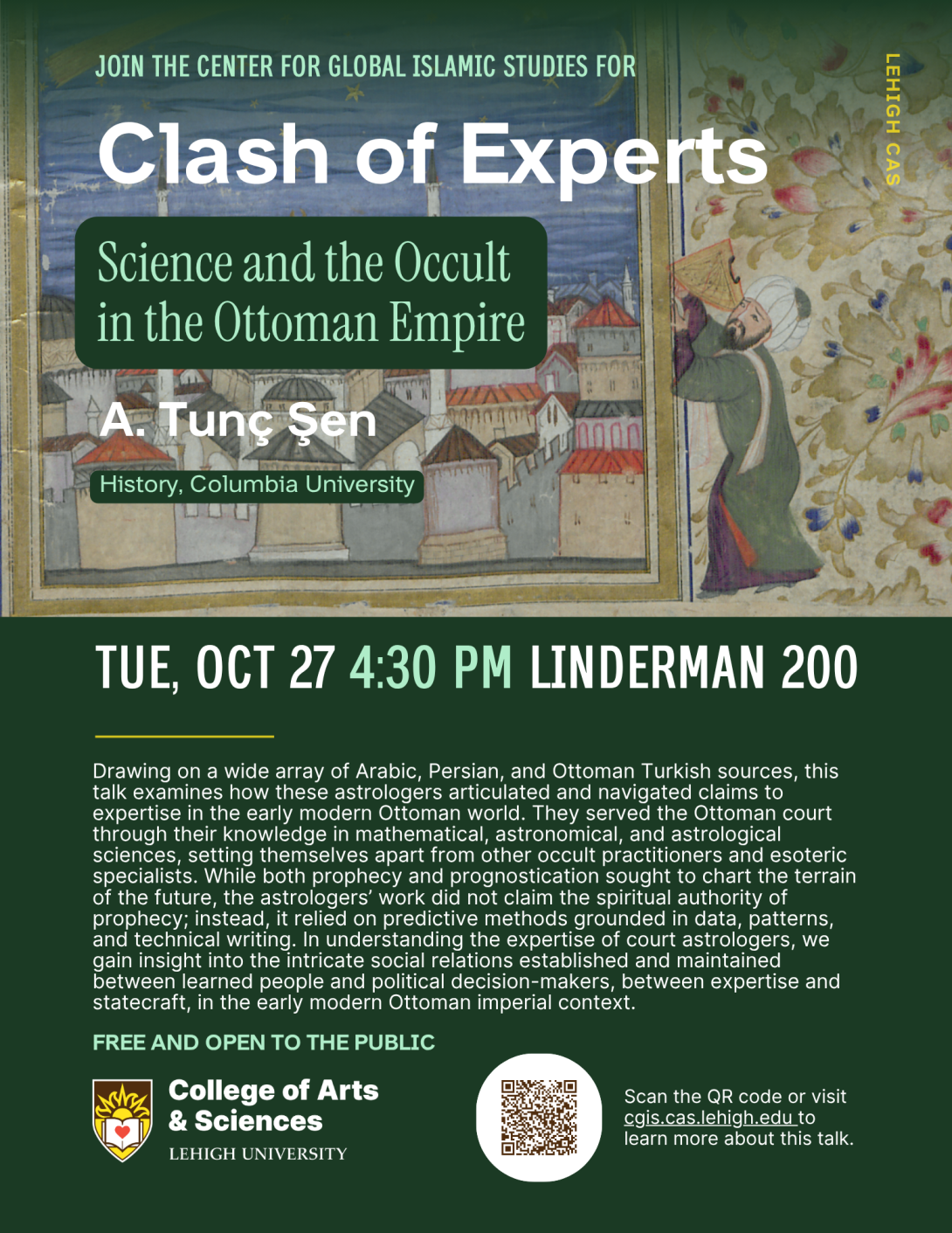
Who had the authority and expertise to predict the future in the past? And what did it mean to be an expert? These are the central questions I investigate in my book, Forgotten Experts: Astrologers, Science, and Authority in the Ottoman Empire, 1450–1600, which takes the Ottoman Empire’s court astrologers as its protagonists. Drawing on a wide array of Arabic, Persian, and Ottoman Turkish sources, this talk examines how these astrologers articulated and navigated claims to expertise in the early modern Ottoman world. They served the Ottoman court through their knowledge in mathematical, astronomical, and astrological sciences, setting themselves apart from other occult practitioners and esoteric specialists. While both prophecy and prognostication sought to chart the terrain of the future, the astrologers’ work did not claim the spiritual authority of prophecy; instead, it relied on predictive methods grounded in data, patterns, and technical writing. In understanding the expertise of court astrologers, we gain insight into the intricate social relations established and maintained between learned people and political decision-makers, between expertise and statecraft, in the early modern Ottoman imperial context.
A. Tunç Şen is Associate Professor of History at Columbia University, specializing in the social and cultural history of the early modern Ottoman Empire and its place in the wider world. He received his B.A. and M.A. from Sabancı University in Istanbul, followed by an M.A. and Ph.D. in Near Eastern Languages and Civilizations from the University of Chicago. Before joining Columbia, Şen taught Ottoman history and paleography at Leiden University. In his research, Şen examines how people perceived their world, the frameworks through which they organized information and beliefs, and the social, political, economic, and emotional structures that both shaped and were shaped by their ways of knowing. He is the author of Forgotten Experts: Astrologers, Science, and Authority in the Ottoman Empire, 1450–1600 (Stanford University Press, 2025), as well as several articles on the history of science and divination, manuscript culture, the history of emotions, and the social history of education in the Ottoman and the broader Islamicate world. He is currently working on two book projects. The first is a social and emotional history of early modern Ottoman scholarly culture, examined through the microhistory of a low-ranking college instructor. The second traces the social and cultural history of Ottoman manuscripts that ended up in European collections as spoils of war or as booty captured by Mediterranean pirates.